

Privacy Policy Generator Ecommerce in 2026: 7 Live Checks Before You Publish
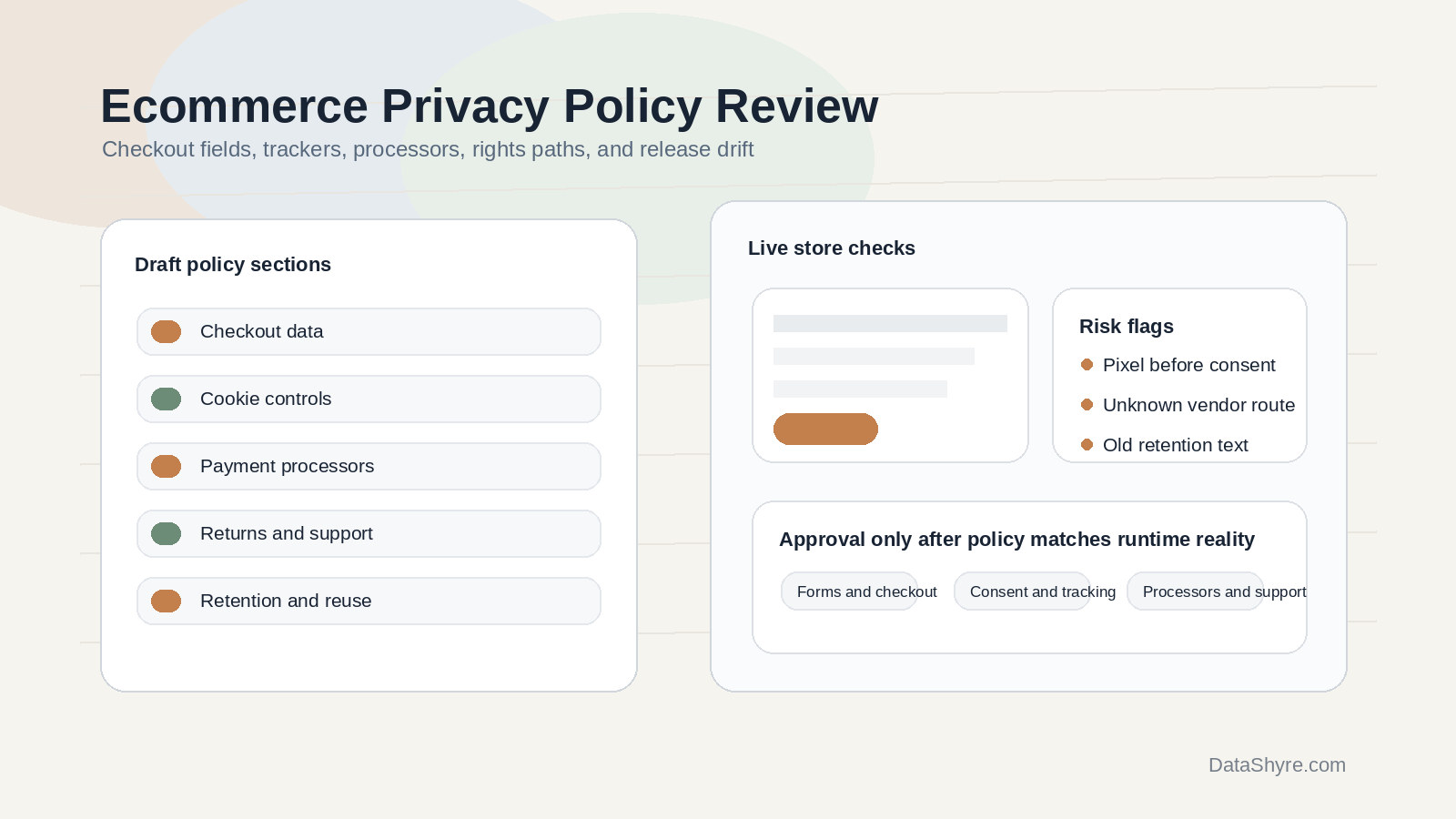
A useful guide to privacy policy generator ecommerce should help readers understand both the rule and the behavior behind the rule. That is where consent topics become genuinely practical instead of sounding like recycled compliance copy.
The practical review for privacy policy generator ecommerce starts when you look past the banner copy and test the live behavior. That is usually where teams find the real gaps: tags firing too early, weak refusal flows, and settings that drift after routine site changes.
That is the real job.
An ecommerce privacy policy generator can absolutely help with structure. It can speed up drafting, organize standard sections, and force the first round of disclosure questions. But it still cannot confirm what your live store actually collects at checkout, which apps receive customer data, which pixels fire before consent, or whether your returns, loyalty, and account-rights flows really match the published page.
The current official guidance still points in that direction. California’s Department of Justice says a notice at collection must link to the privacy policy for a “fuller description” of practices and rights. The CPPA says businesses must post the privacy policy through a link with the word “privacy.” GDPR Article 12 still requires privacy information to be concise, transparent, easily accessible, and written in “clear and plain language.” The ICO says that before drafting privacy information, you need to “know what personal data you have” and what you do with it. The FTC adds the enforcement version plainly: if your company makes privacy promises, the FTC Act requires you to “live up to those claims.”
For adjacent context, start with these guides to best privacy policy generator, website privacy policy generator, and privacy policy for website. This page stays narrower. It is the privacy policy generator ecommerce review I would use this week before publishing policy text for a live store.
If your team is trying to get privacy policy generator ecommerce under control without adding a heavyweight privacy stack, DataShyre can help. DataShyre focuses on retail and ecommerce privacy workflows that are easier to implement, easier to operate, and easier to trust on a live site. Start with DataShyre’s retail and ecommerce privacy workflows or book a demo.
If your team is dealing with policy drift because the storefront, checkout, and app stack have outgrown guesswork, DataShyre can help connect the page to the live stack through implementation review, consent operations, and runtime disclosure checks. The hard part is rarely drafting paragraph one. It is keeping the policy aligned with carts, payment flows, plugins, processors, and marketing systems after the next release.
1. Score the generator against the real store journey, not only the footer page
The first privacy policy generator ecommerce mistake is assuming the policy page is the whole disclosure system.
It is not.
For an ecommerce business, the policy has to stay consistent with the real journey:
- homepage and campaign landing pages;
- product page tracking and merchandising tools;
- cart and checkout fields;
- guest checkout and account creation paths;
- payment, fraud, tax, shipping, and returns workflows; and
- post-purchase email, loyalty, support, and review flows.
This is why a good privacy policy generator ecommerce workflow is not about the prettiest template. It is about whether the generator helps your team disclose what the store really does across the entire revenue path.
2. Make the generated page match point-of-collection notices in checkout and signup flows
California’s DOJ still says the notice at collection must be provided at or before collection and must link to the privacy policy for a fuller explanation.
For ecommerce teams, that means your policy cannot be reviewed in isolation from the screens where data is actually collected.
A serious privacy policy generator ecommerce review should compare the draft against the live collection moments for:
- newsletter capture forms;
- account registration;
- cart and checkout forms;
- financing or installment options;
- returns, warranty, or exchange requests; and
- support, chat, or order-status forms.
If the generated policy sounds complete but the collection screens stay vague, the user still misses context at the moment it matters most.
3. Treat pixels, cookies, and embedded commerce tools as a separate branch
This is one of the easiest ways to overrate a generator.
Many ecommerce privacy generators produce respectable wording for names, emails, orders, and shipping data while flattening runtime tracking into soft phrases like usage information or service providers.
That is rarely enough now.
A better privacy policy generator ecommerce workflow checks whether the draft can honestly explain:
- analytics and advertising pixels;
- consent-dependent cookies and similar technologies;
- embedded reviews, chat, maps, and video tools;
- cart-recovery and remarketing tooling;
- browser or app identifiers shared with third parties; and
- where users can revisit cookie or preference choices later.
If your cookie and privacy layers are drifting apart, fix that before you trust the final page. A privacy policy that promises restraint while the store fires optional tracking early is exactly the kind of mismatch regulators and plaintiffs notice first.
4. Reconcile the generator with the actual vendor stack behind the store
This is where generic privacy generators usually get exposed.
An ecommerce store may share or disclose data to more categories of tools than the marketing page for the generator ever asks about. That often includes:
- payment processors;
- fraud-prevention vendors;
- tax and address-validation services;
- shipping, fulfillment, and returns platforms;
- CRM, email, SMS, loyalty, and review vendors; and
- marketplaces, affiliates, or support tooling.
The CPPA’s current notice guidance is still useful here because it expects businesses to describe categories of personal information, categories of sources, purposes, and categories of disclosure, sale, or sharing over the prior 12 months where applicable.
So when you evaluate a privacy policy generator ecommerce tool, do not ask only whether it can draft a privacy page. Ask whether it forces your team to name the real operational recipients behind checkout, fulfillment, remarketing, and support.
5. Make the rights section operational for store customers, not decorative
The FTC rule here is brutally simple: if your company makes privacy promises, it has to “live up to those claims.”
That makes a privacy policy generator ecommerce review less about tone and more about whether the live store can actually deliver what the page promises.
For an ecommerce site, the rights section should line up with real workflows for:
- access or deletion requests;
- opt-out or sale-sharing controls where applicable;
- account-based preference changes;
- loyalty-program or marketing unsubscribe handling;
- Global Privacy Control or other signal handling where applicable; and
- support escalation when a customer has a privacy question tied to an order.
If the generated page lists rights but sends a shopper into a dead end, the generator has only automated wording. It has not automated trust.
6. Review retention, new uses, and cross-channel reuse before you publish
Ecommerce data rarely stays in one place.
Order data becomes support data. Support data becomes retention data. Email or SMS programs get linked back to purchase history. Marketing teams want to reuse existing customer data for new campaigns or personalization logic.
This is why the ICO’s current transparency guidance matters here. It says privacy information must be kept under review and updated before personal data is used for a new purpose.
For a practical privacy policy generator ecommerce audit, check whether the draft still matches:
- retention periods or retention logic;
- loyalty or rewards reuse of customer data;
- post-purchase marketing and suppression logic;
- new product lines, regions, or channels;
- customer-support tooling added after launch; and
- any change in the purposes for which existing customer data is reused.
This is one of the biggest places where ecommerce privacy pages go stale. The store evolves faster than the policy review habit.
7. Tie the policy generator to release management so the page does not drift after launch
California’s privacy-policy guidance says the policy should be updated at least once a year. For an active ecommerce store, that is the floor, not the operating rhythm.
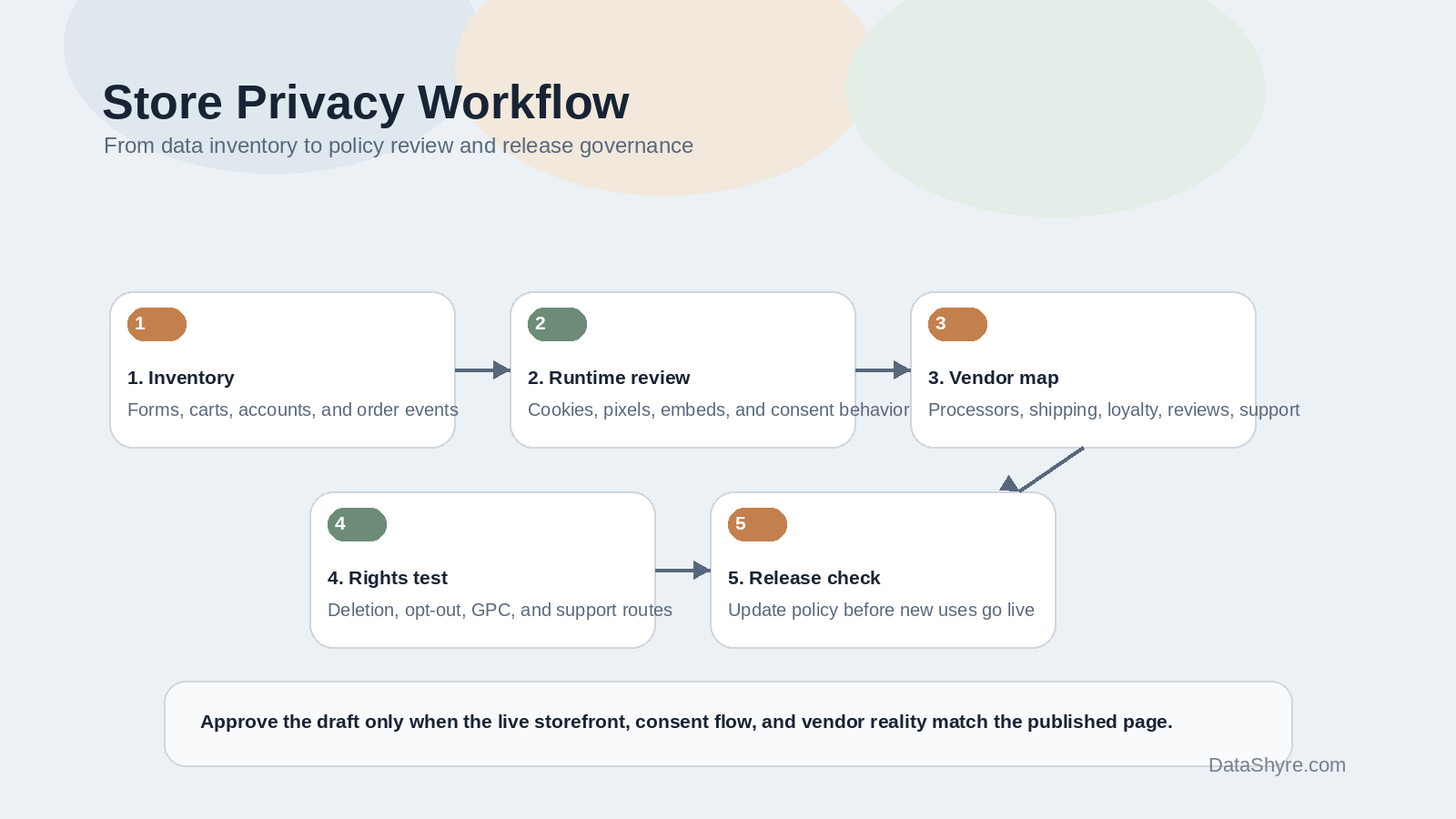
The better privacy policy generator ecommerce workflow is to trigger a re-review whenever the stack changes, including when:
- a new checkout app or payment option goes live;
- a new pixel, SDK, or consent rule is added;
- a new returns or fulfillment vendor is introduced;
- loyalty or remarketing logic changes;
- new regions or rights-handling requirements apply; or
- support starts handling personal data in a different way.
If your generator cannot fit cleanly into that release process, the result will look compliant on day one and misleading by quarter end.
That is also where DataShyre can help most. If your store team already has a draft but does not trust whether it matches the live environment, DataShyre can validate the disclosure layer against the checkout, tracking, and vendor reality rather than just rephrasing the page.
A practical 7-step scorecard for this week
If you were reviewing a privacy policy generator ecommerce option today, I would score it in this order:
- fit with the real store, checkout, and account journey;
- fit with notice-at-collection moments and signup flows;
- honesty about cookies, pixels, and embedded tools;
- coverage of the actual vendor and processor stack;
- clarity of rights and privacy-request handling;
- ability to stay accurate when retention or purposes change; and
- ease of rerunning the review after releases.
That scorecard usually tells you more than the product demo.
FAQ
Can a privacy policy generator for ecommerce make my store compliant by itself?
No. It can speed up drafting, but it cannot verify live checkout behavior, tracking, processors, or request handling on its own.
Should an ecommerce privacy policy mention cookies separately from checkout data?
Usually yes. Storefront data collection and runtime tracking often happen in different ways and involve different systems, so flattening them into one vague paragraph is risky.
What is the biggest risk with a privacy policy generator ecommerce workflow?
Mismatch. The page can look polished while the live store collects, shares, or reuses data in ways the draft does not accurately explain.
Bottom line
The best privacy policy generator ecommerce workflow in 2026 is not the one that writes the fastest store policy.
It is the one that forces your team to check the live storefront, checkout, pixels, processors, rights paths, and update triggers before anything is published.
If the page cannot survive those checks, the generator did not solve the real problem.
Seen clearly, privacy policy generator ecommerce is less about a pop-up and more about whether the site behaves honestly after the visitor makes a choice.
Sources
- California Department of Justice, California Consumer Privacy Act (CCPA): https://oag.ca.gov/privacy/ccpa
- California Department of Justice, How to Read a Privacy Policy: https://oag.ca.gov/privacy/facts/online-privacy/privacy-policy
- California Privacy Protection Agency, What General Notices Are Required by the CCPA?: https://cppa.ca.gov/pdf/general_notices.pdf
- California Privacy Protection Agency, Frequently Asked Questions (FAQs): https://cppa.ca.gov/faq.html
- EUR-Lex, Regulation (EU) 2016/679, Article 12 and Articles 13-14: https://eur-lex.europa.eu/legal-content/EN/TXT/?uri=CELEX:32016R0679
- ICO, Right to Be Informed: https://ico.org.uk/for-organisations/uk-gdpr-guidance-and-resources/individual-rights/individual-rights/right-to-be-informed/
- ICO, How should we draft our privacy information?: https://ico.org.uk/for-organisations/uk-gdpr-guidance-and-resources/individual-rights/the-right-to-be-informed/how-should-we-draft-our-privacy-information/
- FTC, Privacy and Security Enforcement: https://www.ftc.gov/news-events/topics/protecting-consumer-privacy-security/privacy-security-enforcement
- FTC, Health Privacy: https://www.ftc.gov/business-guidance/privacy-security/health-privacy