

EU Cookie Banner in 2026: 7 Live Checks Before You Ship One
A useful guide to eu cookie banner should help readers understand both the rule and the behavior behind the rule. That is where consent topics become genuinely practical instead of sounding like recycled compliance copy.
The practical review for eu cookie banner starts when you look past the banner copy and test the live behavior. That is usually where teams find the real gaps: tags firing too early, weak refusal flows, and settings that drift after routine site changes.
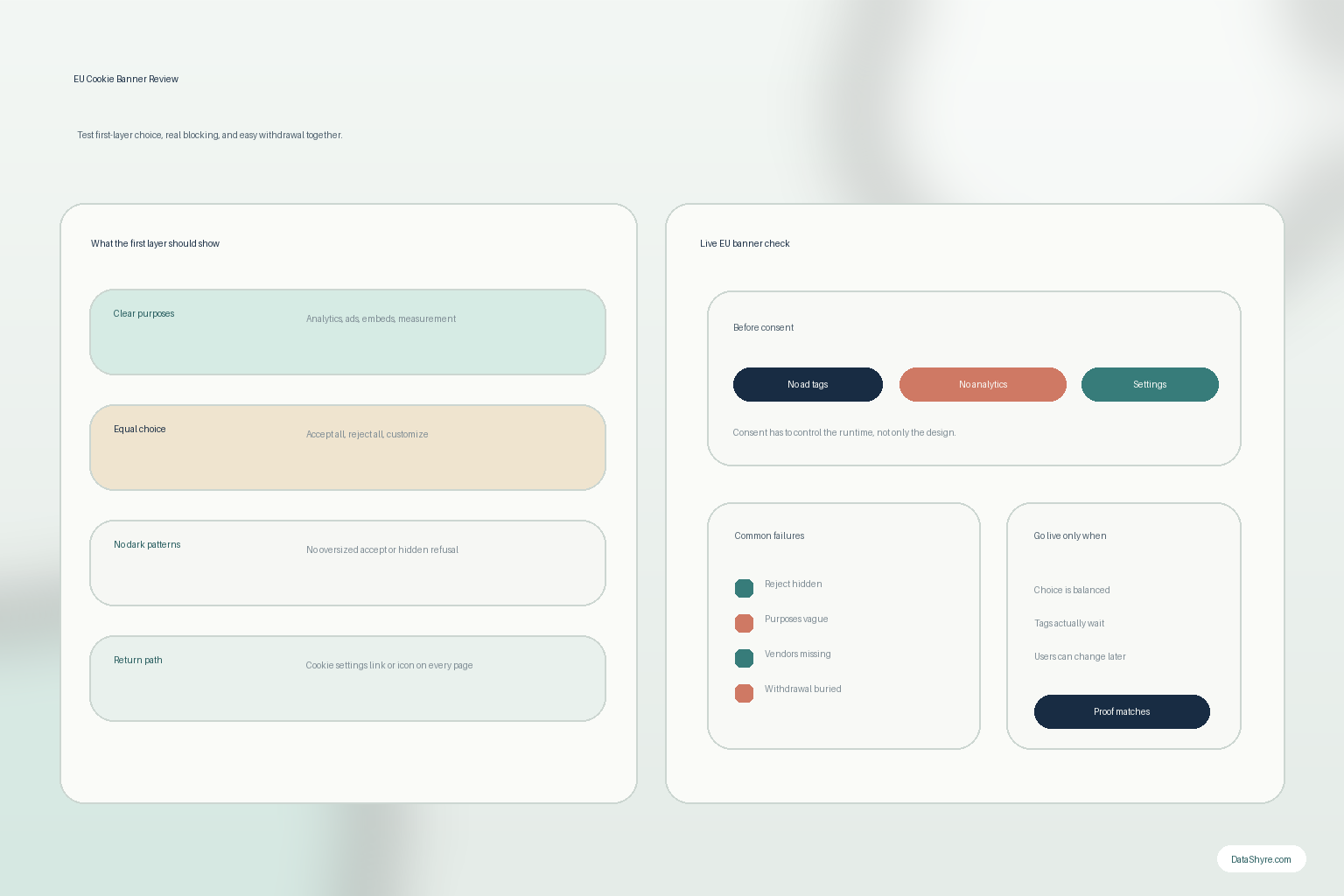
It is closer to defensible when it gives people a real first-layer choice, blocks non-essential technologies before consent, explains purposes in plain language, and lets people change their mind without hunting through the site later.
The current official sources still point in that direction. Article 5(3) of the ePrivacy Directive requires “clear and comprehensive information” and consent before storing or accessing information on a user’s device unless an exception applies. GDPR Article 12 still requires privacy information to be delivered in “clear and plain language.” The Court of Justice of the European Union said in Planet49 that a “pre-checked checkbox” is not valid cookie consent. The EDPB’s Cookie Banner Taskforce report highlighted the “absence of a ‘reject’ button on the first layer” as one of the practices drawing coordinated scrutiny across European authorities. On April 29, 2026, the CNIL refreshed its cookie FAQ and repeated that withdrawing consent should be as easy as giving it, with an always-available manage my cookies path or cookie icon on every page. CNIL’s December 12, 2024 dark-pattern notice also said rejecting cookies should be “just as easy as accepting them.”
If you want nearby context first, start with these guides to cookie banner, european cookie law, and gdpr cookie policy template. This page stays narrower. It is the eu cookie banner review I would use this week before approving a production release.
If your team is trying to get eu cookie banner under control without adding a heavyweight privacy stack, DataShyre can help. DataShyre focuses on consent and preference management that are easier to implement, easier to operate, and easier to trust on a live site. Start with DataShyre’s consent and preference management or book a demo.
If your team wants the banner, policy, vendor inventory, and live runtime to line up instead of drifting apart, DataShyre can help with consent management, data mapping, and implementation review. Most EU banner failures are not copy failures alone. They are systems failures.
1. Treat the EU cookie banner as a runtime control, not a design asset
The first eu cookie banner mistake is judging the banner from a screenshot.
That is not enough.
The real question is what the site does before, during, and after the user interacts with it.
The current EDPB guidance on the technical scope of Article 5(3) also matters here because EU device-access rules are not only about traditional cookies. They can also reach other storage and access methods used by tracking stacks, which means the banner needs to match the real implementation, not just the label on the pop-up.
So the first live check is simple:
- open the site in a clean browser;
- inspect what loads before any click;
- reject all;
- accept all;
- reopen settings and withdraw later.
If optional analytics, advertising, or embedded vendor technologies already run before consent, the eu cookie banner is decoration, not control.
2. Put Accept all, Reject all, and Customize on the first layer
This is where many teams still lose the argument.
The EDPB Cookie Banner Taskforce treated the absence of a reject button on the first layer as a recurring enforcement issue. CNIL’s 2024 dark-pattern action said the same problem can show up through layout tricks, repeated acceptance prompts, or a refusal path hidden in vague wording.
A stronger eu cookie banner should make the first layer obvious:
Accept all;Reject all;Customize.
Those choices do not have to be identical in color or shape to be valid in every possible layout, but they do need to be genuinely easy to understand and easy to reach. If accept is bright, large, and repeated while reject is tiny or delayed, you are creating friction exactly where regulators are already looking.
3. Explain purposes in plain language, not CMP jargon
GDPR Article 12 is the part too many banner teams forget.
Even if the consent mechanism exists, the information still needs to be intelligible and accessible in “clear and plain language.”
For an eu cookie banner, that means the first layer should not force users to decode vague or overloaded labels such as:
improve your experience;partners;legitimate interest tools;performance enhancement.
A more useful setup names the real purposes in plain terms:
- analytics or measurement;
- advertising or retargeting;
- video or map embeds;
- functional preferences, where truly applicable.
The shorter the wording, the more precise it has to be. Plain language is not only a writing preference here. It is part of the legal job.
4. Make the banner, vendor list, and policy tell the same story
An eu cookie banner is weak when the front layer says one thing and the deeper disclosures say another.
The Planet49 judgment is still important on this point because it did not only reject pre-ticked consent. It also reinforced that users need real information, including cookie duration and whether third parties may access the cookies.
That creates a practical review checklist:
- do the banner purposes match the second layer;
- are third-party vendors or controllers identifiable from the first layer or a clearly reachable path;
- does the cookie or privacy policy describe the same categories the banner uses;
- do the durations and vendor roles still match the live stack;
- does a browser test show the same tools the notice describes.
If your banner says analytics but the live site fires ad pixels or social widgets in the same category, the problem is not subtle.
5. Make withdrawal easy from every page
One-click acceptance followed by hidden withdrawal is still a common failure pattern.
CNIL’s updated FAQ on April 29, 2026 said the general rule is that it must be as easy to withdraw consent as to give it. It specifically recommends an always-accessible manage my cookies link or a cookie settings icon available on every page.
That makes the eu cookie banner test practical:
- can a user reopen settings without returning to the homepage;
- is the withdrawal path clear on mobile;
- does rejecting later actually stop future reads or writes from optional third parties;
- can users understand which category to switch off;
- is the settings path visible on every major template.
If users can consent from the hero banner but need detective work to undo it, the design is not balanced.
6. Keep the exemptions narrow
This is where teams talk themselves into trouble.
Article 5(3) of the ePrivacy Directive has exceptions, but those exceptions are not a free pass for anything convenient to the publisher. CNIL’s current FAQ still treats audience measurement as exempt only under specific conditions, and even then the configuration needs to stay narrow.
For a real eu cookie banner review, I would pressure-test any strictly necessary or exempt label by asking:
- is the technology necessary for the service the user explicitly asked for;
- is it really first-party and function-limited;
- does it avoid broader cross-site or cross-service tracking;
- has the team documented why the exemption applies;
- would a skeptical reviewer accept that description after watching the network activity.
When exemptions become a dumping ground for analytics or ad-tech convenience, the banner stops reflecting reality.
7. Re-test the banner every time the stack changes
The safest-looking eu cookie banner can fail after the next marketing or CMS update.
This is why this should be part of release governance, not a one-time legal clean-up.
Re-test when:
- a new vendor or pixel is added;
- tag-manager rules change;
- a CMP template is revised;
- embedded video, maps, chat, or scheduling tools are introduced;
- the policy or vendor list is edited;
- new country logic or language versions are published.
If the banner is not tied to change management, it will drift faster than most teams expect.
A practical EU cookie banner review for this week
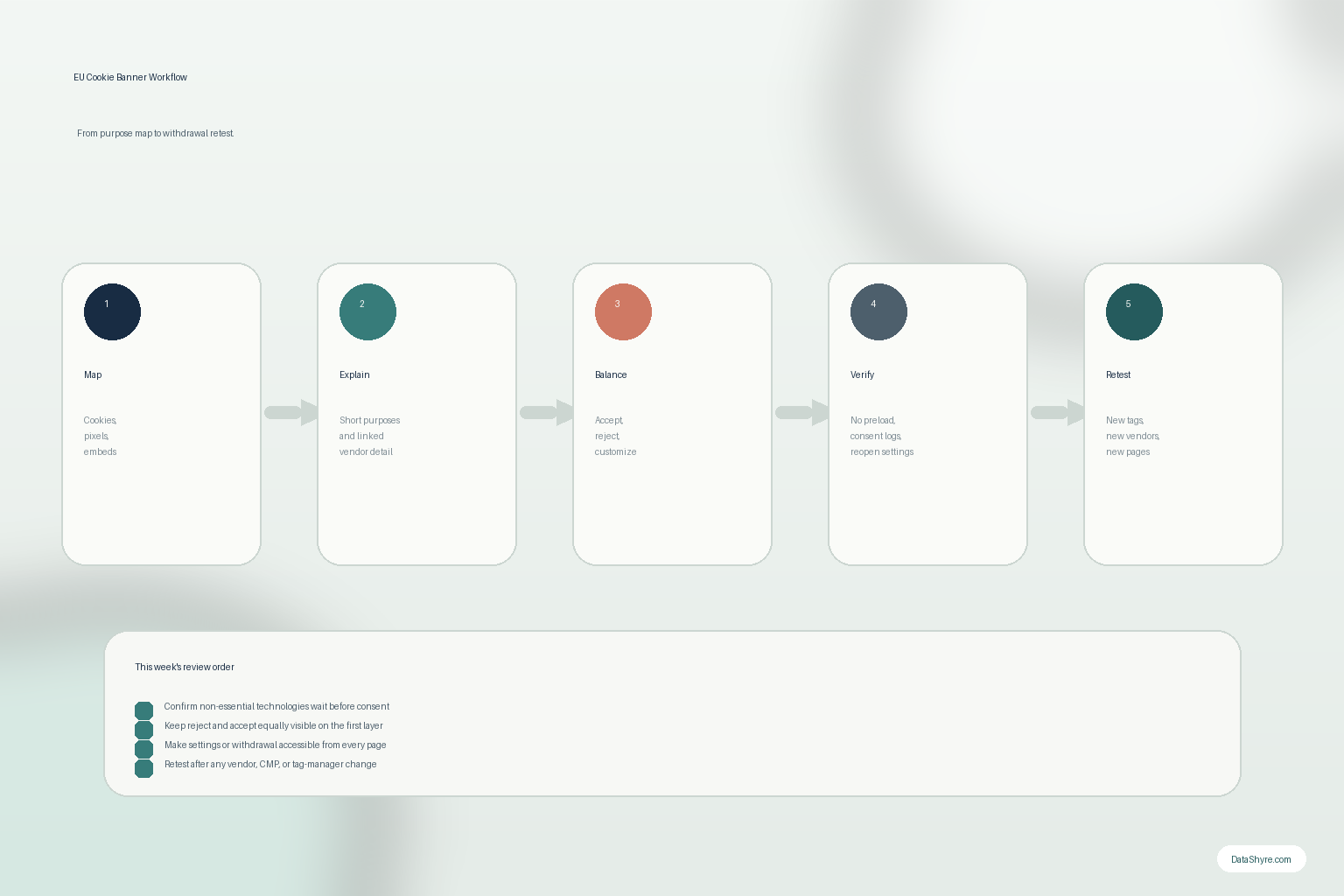
If you were reviewing an eu cookie banner today, use this order:
- inventory the real cookies, scripts, pixels, embeds, and local-storage behavior;
- test first-load behavior in a clean browser before any choice is made;
- compare first-layer accept, reject, and customize prominence on desktop and mobile;
- verify that purpose labels and vendor disclosures are clear and reachable;
- test reopening settings and withdrawing later from several page templates;
- compare the live runtime against the policy, category labels, and vendor list;
- repeat the test after any release that changes tags, vendors, or page components.
That process tells you much more than asking whether the banner looks polished.
FAQ
Does an EU cookie banner need a reject button on the first layer?
The current enforcement direction strongly favors an easy first-layer refusal path. The EDPB taskforce and CNIL materials both make clear that hiding rejection is a real risk.
Can an EU cookie banner rely on pre-ticked consent or continued browsing?
No. Planet49 rejected pre-ticked consent, and CNIL’s current FAQ says continued browsing should no longer be treated as valid consent.
Is a cookie icon or manage my cookies link enough by itself?
Not by itself. It helps with withdrawal, but the site still needs valid prior consent where required, clear purposes, and runtime behavior that matches the banner.
Bottom line
The best eu cookie banner in 2026 is not the one with the prettiest modal.
It is the one that gives a real first-layer choice, explains the purposes plainly, blocks optional technologies before consent, makes later withdrawal easy, and stays aligned with the actual vendor stack.
If those pieces line up, the banner is doing useful compliance work.
Seen clearly, eu cookie banner is less about a pop-up and more about whether the site behaves honestly after the visitor makes a choice.
Sources
- EUR-Lex, Directive 2002/58/EC Article 5(3): https://eur-lex.europa.eu/eli/dir/2002/58/art_5/par_3/oj/eng
- EUR-Lex, Regulation (EU) 2016/679 (GDPR), Article 12: https://eur-lex.europa.eu/eli/reg/2016/679/oj/eng
- EUR-Lex, Planet49 (Case C-673/17): https://eur-lex.europa.eu/legal-content/EN/TXT/?uri=CELEX%3A62017CJ0673
- European Data Protection Board, Report of the work undertaken by the Cookie Banner Taskforce: https://www.edpb.europa.eu/documents/task-force-report/report-of-the-work-undertaken-by-the-cookie-banner-taskforce_en
- European Data Protection Board, Guidelines 2/2023 on Technical Scope of Art. 5(3) of the ePrivacy Directive: https://www.edpb.europa.eu/documents/guideline/guidelines-22023-on-technical-scope-of-art-53-of-eprivacy-directive_en
- CNIL, Questions-réponses sur les lignes directrices modificatives et la recommandation « cookies et autres traceurs », updated April 29, 2026: https://www.cnil.fr/fr/cookies-et-autres-traceurs/regles/cookies/FAQ
- CNIL, Dark Patterns in Cookie Banners: CNIL issues formal notice to website publishers, December 12, 2024: https://cnil.fr/en/dark-patterns-cookie-banners-cnil-issues-formal-notice-website-publishers