

GDPR Data Protection in 2026: 7 Live Checks for Scope, Notices, Rights, and Proof
A useful guide to gdpr data protection should help readers understand both the rule and the behavior behind the rule. That is where consent topics become genuinely practical instead of sounding like recycled compliance copy.
The practical review for gdpr data protection starts when you look past the banner copy and test the live behavior. That is usually where teams find the real gaps: tags firing too early, weak refusal flows, and settings that drift after routine site changes.
GDPR data protection is the operating system that decides what personal data you collect, why you collect it, how clearly you explain it, who touches it, how long it stays, what rights people can use, and what evidence you can produce when someone asks questions later.
That is also where the current official sources still point. The European Commission’s business guidance still says the GDPR applies when processing happens in the context of an EU establishment, when a non-EU company offers goods or services to people in the EU, or when it monitors their behaviour there. The same official guidance still anchors compliance in the seven principles, lawful basis, transparency, rights handling, and technical and organisational measures. On March 19, 2026, the European Data Protection Board launched its 2026 Coordinated Enforcement Framework on “transparency and information obligations” under GDPR Articles 12, 13, and 14. That is a good clue about what a serious gdpr data protection review should look like this year.
If you want nearby context first, start with these guides to general data protection regulation, GDPR requirements, and GDPR compliant privacy notice. This page stays practical. It is the gdpr data protection review I would use this week before telling a team their program is ready.
If your team is trying to get gdpr data protection under control without adding a heavyweight privacy stack, DataShyre can help. DataShyre focuses on consent and preference management that are easier to implement, easier to operate, and easier to trust on a live site. Start with DataShyre’s consent and preference management or book a demo.
If your team already has policies but needs help lining them up with live systems, DataShyre can help with data mapping, DSR automation, consent management, and implementation review. The expensive failures usually happen between the policy page and the production stack.

1. Settle scope and roles before you argue about wording
The first gdpr data protection mistake is starting with banner copy, policy copy, or contract templates before anyone has confirmed whether the GDPR applies and who is doing what.
The European Commission still frames scope around three practical triggers:
- processing in the context of an EU establishment;
- offering goods or services to people in the EU; or
- monitoring the behaviour of people in the EU.
That means a useful gdpr data protection review should start by asking:
- which products, sites, apps, or forms touch EU personal data;
- whether the business is acting as controller, processor, or sometimes both depending on the workflow;
- whether marketing, analytics, support, and product teams are all telling the same role story.
If those answers are fuzzy, everything downstream usually becomes fuzzy too.
2. Use the seven principles as operating checks, not wall art
The European Commission still says companies and organisations must respect the GDPR’s seven key principles, starting with “lawfulness, fairness and transparency.”
That matters because gdpr data protection is not just about having lawful text somewhere in the footer. It is about whether day-to-day decisions line up with those principles in practice:
- are you collecting data for a defined purpose;
- are you limiting collection to what is actually needed;
- are retention periods real instead of indefinite by habit;
- are records accurate enough to support rights requests;
- are access and security controls proportionate to the sensitivity and context;
- can the team show accountability instead of assuming it.
The principle set is still the fastest way to spot drift. If a workflow keeps more data than it can justify, reuses it for a different purpose, or exposes it too broadly, the problem is already bigger than copy cleanup.
3. Match each processing purpose to a real lawful basis
Another common gdpr data protection failure is acting as if consent is the safe answer to every processing question.
The European Commission’s current lawful-basis guidance still lists six possible grounds for lawful processing:
- consent;
- contract;
- legal obligation;
- vital interests;
- public task; and
- legitimate interests.
So for gdpr data protection, the better review question is not do we have consent somewhere.
It is:
- what exact purpose is this data supporting;
- which lawful basis fits that purpose;
- does the notice explain that basis honestly;
- does the operational workflow still match the stated basis.
This matters because a rights workflow, retention logic, or withdrawal path often breaks when the organisation says one basis in the policy but behaves as if it is relying on another.
4. Put transparency where collection actually happens
This is where the EDPB’s 2026 enforcement theme becomes operational.
GDPR Article 12 still requires information in “clear and plain language.” The Commission’s obligations guidance still points teams back to Articles 12 through 14, including timing rules for information provided directly to individuals and for data obtained from another source.
For a real gdpr data protection review, that means checking:
- whether form notices appear before or at collection;
- whether mobile and app flows carry the same clarity as desktop flows;
- whether the privacy notice reflects the real categories, purposes, recipients, transfers, and retention story;
- whether indirect collection gets explained within the required timing window.
A footer link alone is not enough if the data-heavy workflow lives in a sales form, onboarding screen, support tool, or embedded vendor flow.
5. Treat rights handling like a response workflow, not a page link
Many teams can list the GDPR rights from memory and still fail the operational test when someone actually uses one.
The Commission’s current business guidance still says organisations must reply to requests without undue delay and, in principle, “within 1 month” of receiving the request.
That turns gdpr data protection into a workflow question:
- how do you intake access, deletion, correction, objection, portability, or restriction requests;
- how do you verify identity without adding unnecessary friction;
- which internal owners gather the relevant data;
- which processors or vendors also need instructions;
- how do you document what happened and when.
If your rights route works only for one CRM field or one app table, the program is weaker than it looks.
6. Review vendors, transfers, and high-risk processing before launch
A lot of gdpr data protection problems are not created by core product code. They are created by what the core product calls, embeds, exports, syncs, or shares.
The European Commission’s obligations guidance still stresses processor contracts, appropriate safeguards, security measures, and data protection impact assessments where processing is likely to create high risk to individuals’ rights and freedoms. The same guidance still describes a DPIA as something that should be conducted before processing begins and treated as a living tool rather than a one-off document.
So a stronger gdpr data protection review asks:
- which vendors receive personal data and for what purpose;
- whether processor and controller roles are documented accurately;
- whether international transfer logic is understood instead of assumed;
- whether any workflow requires a DPIA because of large-scale sensitive processing, systematic monitoring, or automated evaluation;
- whether residual risks have an escalation path before launch.
This is also where many website or app teams under-scope the problem. A privacy policy can look clean while analytics, chat, support, payments, enrichment, and ad-tech tools are each creating their own data-protection obligations.
7. Build proof into the system from the start
The Commission’s obligations guidance still says organisations should apply “data protection by design” and by default from the earliest stages of processing design.
That makes gdpr data protection an evidence problem as much as a legal one.
You want to be able to show:
- the current notice text and where it appears;
- the mapped purposes and lawful bases;
- retention rules and access controls;
- processor inventory and review notes;
- DPIA decisions where relevant;
- request logs and response timing;
- change-management triggers when the stack evolves.
Without that layer, teams end up re-discovering the program from scratch every time a customer, regulator, buyer, or security reviewer asks a hard question.
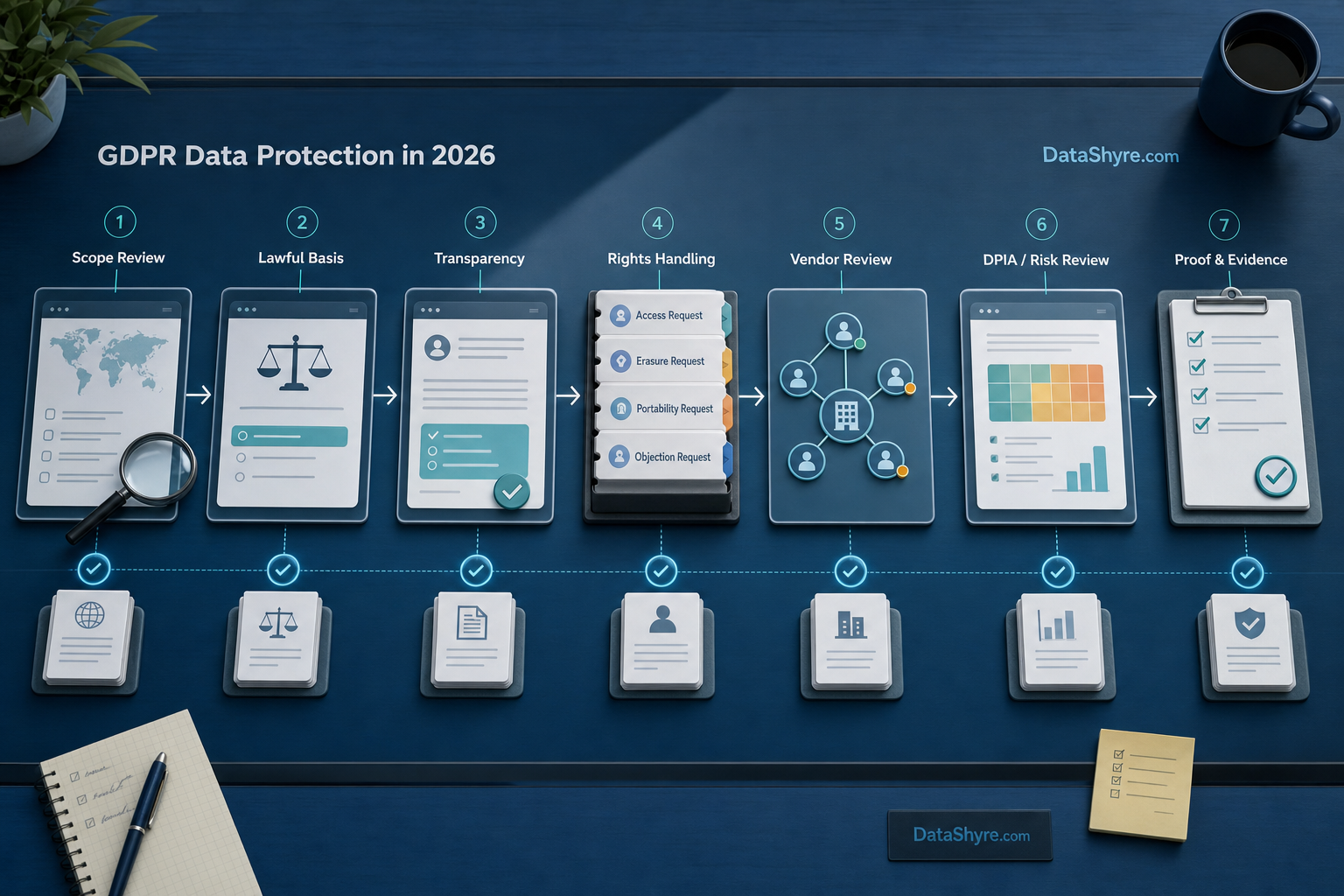
A practical GDPR data protection review order for this week
If you were reviewing gdpr data protection today, I would do it in this order:
- confirm scope, roles, and main processing journeys;
- map each purpose to a lawful basis;
- compare notices against the real collection points;
- test the rights workflow end to end;
- review vendors, transfers, and DPIA triggers;
- capture the evidence needed to prove the current state.
That order usually surfaces more truth than rewriting the policy page first.
FAQ
What does GDPR data protection mean in practice?
In real deployments, gdpr data protection means controlling the full personal-data lifecycle: collection, purpose, lawful basis, disclosure, access, retention, sharing, rights handling, and proof.
Is GDPR data protection just about privacy notices?
No. Notices matter, but they are only one layer. A team can have a polished notice and still fail on rights handling, vendor governance, retention, transfers, or evidence.
When do you need a DPIA under GDPR?
The European Commission says a DPIA is required when processing is likely to result in a high risk to individuals’ rights and freedoms, including certain forms of large-scale sensitive processing, systematic monitoring, or automated evaluation.
Bottom line
The best gdpr data protection program in 2026 is not the one with the prettiest policy page.
It is the one that can explain scope, justify purpose, show lawful basis, surface clear notices, fulfill rights, control vendors, and prove the whole thing without improvising.
Seen clearly, gdpr data protection is less about a pop-up and more about whether the site behaves honestly after the visitor makes a choice.
Official sources used
- https://commission.europa.eu/law/law-topic/data-protection/information-business-and-organisations/application-gdpr_en
- https://commission.europa.eu/law/law-topic/data-protection/information-business-and-organisations/principles-gdpr_en
- https://commission.europa.eu/law/law-topic/data-protection/information-business-and-organisations/legal-grounds-processing-data_en
- https://commission.europa.eu/law/law-topic/data-protection/information-business-and-organisations/obligations_en
- https://commission.europa.eu/law/law-topic/data-protection/information-business-and-organisations/dealing-requests-individuals_en
- https://www.edpb.europa.eu/news/cef-2026-edpb-launches-coordinated-enforcement-action-on-transparency-and-information_ga